The Therapy
Non-invasive, clinically proven optic nerve stimulation that supports and restores vision.
10-Day Protocol
Your treatment journey
A complete Eyetronic therapy cycle is structured to deliver consistent, individually tailored stimulation.
Before
Treatment start
Analysis of the disease course
Day 1
First session
Diagnosis and first therapy session
Day 2–9
Core therapy
Further therapy sessions
Day 10
Final session
Last therapy and final examination
After
Aftercare
Monitoring the development
Why it matters
Glaucoma in numbers
#1
80M → 100M
2 – 3%
$2.9B
Background
What is Glaucoma?
Glaucoma is a disease of the optic nerve causing progressive loss of the visual field. It is the leading cause of blindness in the world. 80 million patients suffer from glaucoma worldwide — a number that is set to rise sharply over the coming decades.

Limitations of Standard Therapy
Current glaucoma management focuses on the eye — specifically on lowering intraocular pressure (IOP). The cost for minimally invasive glaucoma surgery (MIGS) in the US ranges from $3,700 to $7,100 per patient. Despite these interventions, many patients continue to lose vision. Notably, 40% of patients have normal-tension glaucoma (NTG), and in Asia this figure rises to 70%. While treating elevated IOP is necessary, it is not sufficient to halt disease progression.
A New Focus: the Optic Nerve
Glaucoma is fundamentally a neuropathy of the optic nerve. Scientific research shows that electrical stimulation can activate nerves. The goal is to stimulate the optic nerve before irreversible structural loss and apoptosis (cell death) occur. Once nerves lose their function, vision is permanently lost. Eyetronic’s approach shifts the focus from just the eye to the preservation and restoration of optic nerve function.
Mechanism of Action
Optic nerve stimulation by Eyetronic increases neurotrophic factors (such as IGF-1, BDNF, CNTF, FGF-2), enhances immunomodulation, and improves perfusion. It also boosts glutamine synthetase and caspase 3 activity. These changes lead to both functional and structural neurorestoration, including axonal growth, recovery of visually evoked potentials (VEP), and improved survival of retinal ganglion cells after injury.
Optic Nerve Stimulation
Eyetronic’s technology re-engages nerve cells using non-invasive electrical currents to drive neuronal activity. The presence of phosphenes serves as a biomarker for successful stimulation. A typical treatment cycle consists of 10 sessions. To date, over 1,200 patients have undergone more than 12,000 sessions, with no serious adverse events reported — demonstrating both the safety and efficacy of the method.
Clinical Results – Vision Restoration
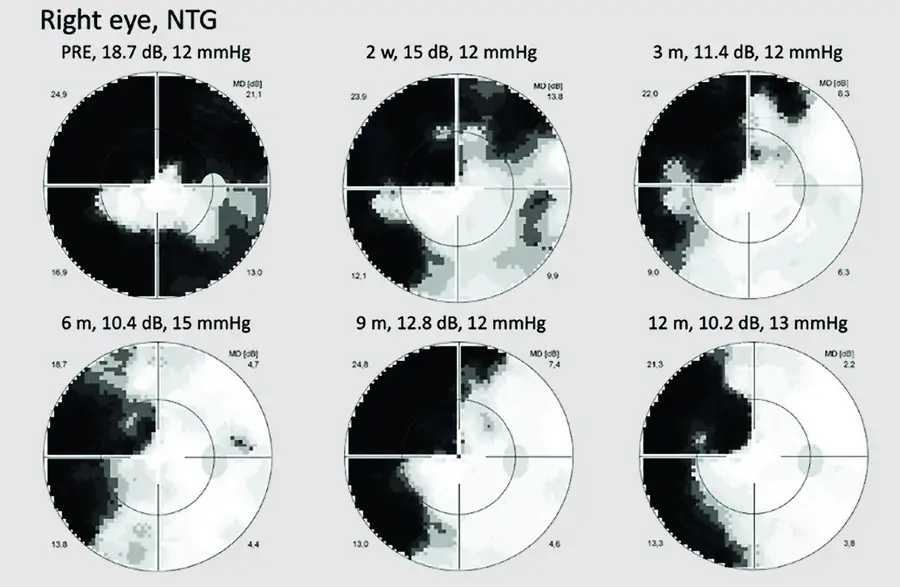
Twelve-month post-market clinical follow-up (PMCF) results show that Eyetronic’s therapy can reverse vision loss, leading to measurable improvement. Perimetry tests (including mean defect and IOP values) confirm these gains. Patient testimonials report significant improvements in visual field, color perception, and the ability to recognize faces and see at a distance — benefits that were not possible before treatment.
Clinical Efficacy in IOP Patients
Long-term PMCF data confirm that Eyetronic’s therapy halts visual field loss in patients with elevated IOP. In a cohort of 101 eyes, there was a significant improvement in visual field mean defect (dB) as measured by perimetry. Eyetronic offers an effective adjunct or alternative for patients who do not sufficiently benefit from standard IOP-lowering treatments.

Clinical Efficacy in NTG Patients
Eyetronic’s effectiveness extends to patients with normal-tension glaucoma (NTG). Twelve-month follow-up data from 19 NTG patients, as well as three-month data from 18 additional NTG patients, show consistent improvements in visual field. These results, presented at major ophthalmology congresses, further validate the broad applicability of Eyetronic’s optic nerve stimulation therapy across glaucoma subtypes.
The benefit of alternating-current stimulation has already been shown in neurology, and we know that the principle works. We are now transferring this experience to ophthalmology. A great advantage for patients is that the therapy is generally painless and that only a few temporary side effects have occurred so far.
Prof. Dr. Carl Erb, glaucoma expert and medical director of the Augenklinik am Wittenbergplatz, Berlin.
The treatment journey
How a treatment cycle works
Initial assessment & eligibility
~ 1 day, on-site
10 sessions over 10 business days
2 weeks, outpatient
Follow-up & long-term care
Ongoing monitoring
Frequently asked questions
What patients ask most
1. Who is a candidate for Eyetronic therapy?
Eyetronic therapy is designed for patients with optic nerve damage where some nerve function remains — most commonly glaucoma (primary open-angle, normal-tension, and others), but also ischemic and post-traumatic optic neuropathies. The treatment is most effective when initiated before complete optic nerve atrophy.
Final eligibility is determined during the initial on-site assessment with one of our certified ophthalmologists.
2. Does the treatment hurt?
No. The therapy is non-invasive: gentle alternating-current pulses are applied through electrodes placed on the skin around the eye. Most patients describe the sensation as a mild tingling or a soft flicker of light — completely tolerable and pain-free.
3. How many sessions do I need and how long does each take?
A full cycle is 10 sessions, conducted on 10 consecutive business days (Monday–Friday over two weeks). Each session lasts approximately 60 minutes. The schedule is intentionally compact so the optic nerve receives consistent stimulation across short intervals.
4. How long do the effects last?
Twelve-month post-market clinical follow-up data show that approximately three out of four patients exhibit stable or improved visual field one year after treatment. Repeat treatment cycles are possible and can be planned with your treating physician.
5. What are the possible side effects?
Eyetronic has been applied to more than 1,000 patients in Europe with no serious adverse events reported. Mild, temporary effects can include slight skin redness around the electrode contact points and a brief tingling sensation during the session.
6. Does Eyetronic replace my eye drops or surgery?
No — Eyetronic is a complementary therapy, not a replacement. Patients are advised to continue their standard glaucoma management (IOP-lowering eye drops, laser, or surgical interventions) under the care of their treating ophthalmologist.
7. Will my health insurance cover the cost?
Coverage depends on country, insurance plan, and individual case. The team at each certified therapy center can advise on private insurance reimbursement, self-pay options, and any local funding pathways.
8. Where can I receive the treatment?
Eyetronic is currently available at certified centers across Europe (Germany, Spain and selected partners) and is being introduced in the United States through clinical trials at the Glaucoma Center of San Francisco, Stanford University and UCSF.
See our Clinics page for a full list and contact details.
Downloads
More information about the Eyetronic therapy
Get in touch
Find a certified Eyetronic clinic
Eyetronic therapy is offered at selected centers across Europe.